How to Add a Cybersecurity Practice to Your MSP Without Hiring a CISO
Every MSP owner has the same problem. Cybersecurity is in every renewal conversation, but the delivery capability isn't there. Here are the three paths forward, with real numbers.
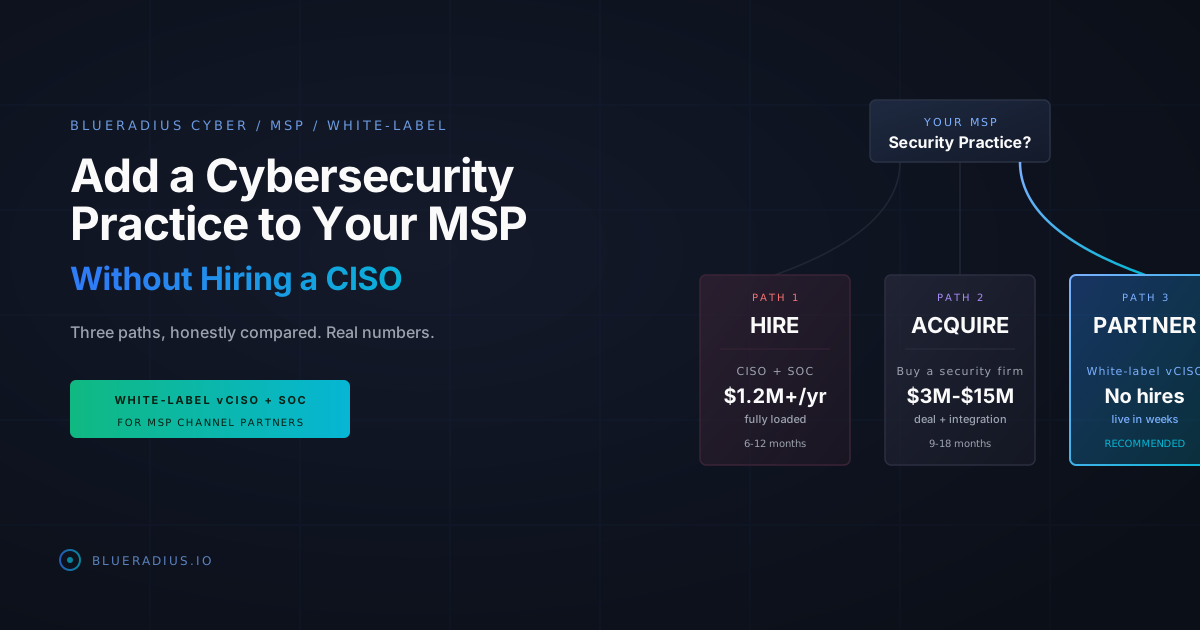
Every MSP owner I talk to has the same problem right now. Cybersecurity is coming up in every renewal conversation, clients are asking for SOC 2 readiness and 24/7 monitoring, and the MSP's answer is usually some version of "we're looking into it." The pipeline is real. The delivery capability isn't. And the conventional answer, hire a CISO and a couple of analysts, turns out to be either wildly expensive or dangerously slow, depending on your size.
This post walks through every path to a real cybersecurity practice for an MSP that doesn't already have one. Hiring, acquiring, and partnering, with the actual numbers and the honest tradeoffs. It also says which path fits which MSP profile, so you can pick the one that matches your business instead of whichever one a vendor is selling you.
Why MSPs Have to Solve This in 2026
Three pressures are forcing the issue at the same time.
- Compliance is cascading downstream. Clients in healthcare, fintech, and the defense supply chain are required to demonstrate SOC 2, HIPAA, and CMMC programs. When they ask their MSP to support that, "we don't really do security" is not a safe answer anymore.
- Cyber insurance underwriters are specific. Renewal applications now ask about 24/7 monitoring, documented incident response, MFA enforcement, and EDR deployment. Clients expect their MSP to be the answer to those questions, not the reason premiums went up.
- Competitors with a security story are winning renewals. If your pitch is "we handle the IT," and the next MSP's pitch is "we handle the IT and the security, with a CISO you can talk to," you are losing that deal on the demo, regardless of price.
CompTIA's 2024 State of the Channel report puts cybersecurity as the fastest-growing MSP service category for the third year in a row. That is not a trend. That is the business reshaping around you.
The Real Cost of Building In-House
Before anyone commits to hiring, it's worth running the real number on what a credible in-house security practice actually costs. Not the marketing number. The one that shows up in your P&L.
- Chief Information Security Officer: $250K to $400K base salary at mid-market scale, plus benefits and bonus, fully loaded $350K to $520K. Six to twelve months to hire if you can find someone who will take the role.
- Senior security engineer: $150K to $200K, plus benefits. You need at least one to run the day-to-day.
- 24/7 SOC analysts: Real round-the-clock coverage needs roughly eight analysts to cover three shifts with redundancy. At $85K to $115K each, that is $680K to $920K in payroll, for the staffing alone, before any tooling.
- SIEM licensing: $50K to $300K per year depending on data volume and vendor. Splunk, Elastic, Microsoft Sentinel, and Chronicle are all in this range at serious scale.
- EDR across client endpoints: $30 to $80 per endpoint per year depending on vendor. If you are protecting several thousand endpoints across clients, this adds up quickly.
- Compliance automation tooling: $15K to $100K per year for Drata, Vanta, Hyperproof, or Radius360, depending on client count.
A modest in-house practice, with a CISO, one senior engineer, a 24/7 SOC team, and baseline tooling, is a $1.5M to $2.5M fully-loaded first-year commitment. You need that in place before you can serve the first client at the level your competitors are promising.
That is the real number. Most MSPs can't carry it for the 18 to 24 months it takes to get to break-even on the practice. The ones that can usually regret how much capital they tied up along the way.
Your Three Paths (And Who Each One Actually Fits)
There are exactly three ways to get a cybersecurity practice live. Build it, buy it, or borrow it. Every option is a real option. None of them is universally right.
Path 1: Build it in-house
What it looks like: Hire a CISO. Hire senior engineers. Staff a SOC. Build playbooks. Stand up the compliance program. Go to market under your brand, with everything owned.
Pros: Full control over delivery quality. No margin sharing. Builds real enterprise equity value if you ever sell the MSP. Deep integration with your existing NOC and help desk.
Cons: 18 to 24 months to first security revenue. High burn before breakeven. Recruitment risk is real, and CISO-level candidates are scarce. Significant management overhead adding a practice your leadership doesn't have reps running.
Fits: MSPs with $30M+ revenue, a multi-year strategic commitment, access to security talent in their market, and the patience to run a long investment cycle. If that is not you, this path is usually the wrong one.
Path 2: Acquire a small security firm
What it looks like: Buy a regional cybersecurity consultancy or MSSP. Merge their team and book with yours. Rebrand or sub-brand. Leverage the acquired certifications, client list, and delivery IP.
Pros: Instant capability. Credentialed staff already on the payroll. An existing book of security clients you can cross-sell IT services to. Strategic positioning if the target has a specific certification, geography, or industry vertical you want.
Cons: Typical purchase price $2M to $10M for a small firm. Integration risk is enormous, cultural fit between IT services and security practitioners is rarely clean. Key-person risk if the founder leaves. Diligence on delivery quality is hard unless you already have security leadership inside to evaluate.
Fits: MSPs with available capital, prior M&A experience, and a specific strategic reason beyond "we need security." If you are acquiring to add capability you could also partner for, you are probably paying a premium for integration headaches.
Path 3: Partner with a specialist
What it looks like: Find a cybersecurity firm with a channel program built for MSPs. Enroll in a partnership model that fits your situation. Refer clients, white-label their delivery under your brand, or license their platform for your own team to run. Revenue in weeks, not years.
Pros: First security revenue inside 4 to 6 weeks. Zero hiring risk. The delivery team is already built, trained, and experienced. Scales with your pipeline instead of forcing you to build ahead of demand. Lower capital commitment. You retain the client relationship.
Cons: Margin share on delivery. You set client-facing pricing and keep the difference between that and the wholesale rate, which is a real gap but smaller than a fully in-house model would produce. Some dependency on the partner's quality and continuity. Less pure "equity value" in your business compared to fully-owned in-house delivery, though this is usually overstated.
Fits: Most mid-market MSPs. Small MSPs (under 25 clients) testing whether security is a real demand in their base. Large MSPs (200+ clients) who want to validate the market before deciding to build. Essentially any MSP that wants to be earning security revenue this quarter instead of next year.
The Math on the Partnership Path
Most MSPs underestimate how quickly partnership revenue ramps. The specific numbers depend on service mix, client size, and the wholesale pricing you negotiate, so a generic projection doesn't help anyone. What is consistent across partner profiles is the shape:
- First security revenue in weeks, not quarters.
- Incremental recurring revenue per client scales with service depth. A basic SOC 2 readiness engagement is a different number than a full vCISO plus 24/7 SOC plus compliance bundle.
- Services margin for MSPs comes from the gap between the wholesale price and the client-facing price you set. That gap is real and negotiable.
- Zero hiring-risk cost. You don't carry an unoccupied CISO salary for six months if pipeline slips.
The punchline: partnership math pays faster than hiring math because you don't pay to build capacity ahead of demand. The only scenario where hiring wins on raw numbers is at significant scale over a multi-year horizon, which is why that path mostly fits the largest MSPs.
Before you sign anything, a serious partner will walk you through the specific projection against your actual book of clients. If they won't, that is information about how they run the partnership.
How to Pick a Partner Without Getting Burned
Not every cybersecurity channel program is real. Some are repackaged reseller channels with a consulting logo on top. Some are single-person firms trying to scale through partners. The difference matters when your client is in an incident at 2am.
Green flags to look for:
- Senior practitioners doing the actual delivery. The person on your client's incident call should be a CISSP with real investigation experience, not a tier-1 analyst reading a script. Ask directly.
- Documented SLAs with response windows. "We'll get back to you quickly" is not an SLA. A real partner publishes response tiers in the statement of work.
- Client protection language in the partnership agreement. If a partnership ends, your client stays with you, not with the vendor who delivered under your brand. This should be explicit.
- Reference checks with existing MSP partners. If a channel program is real, it has partners. If it doesn't have partners who will talk to you, it isn't real yet.
- A platform that is actually multi-tenant. Several of the top GRC platforms are single-tenant products with a dashboard bolted sideways. A real multi-tenant platform has per-client isolation, cross-framework mapping, and reporting built for service providers from the ground up.
Red flags to walk away from:
- Vague pricing or no wholesale structure. If a vendor wants to talk about "partnership" but can't show you a wholesale price sheet, they mean "reseller," and the margin will be thin.
- One-sided non-competes. Clauses that prevent you from working with any other security vendor, without reciprocal protections, are a signal about how they will treat you once signed.
- Pressure to sign minimum commitments before you see delivery. A serious partner lets you pilot with one or two clients before asking you to commit.
- No clear escalation path. When an incident goes sideways, who do you call? If the answer is "open a ticket," keep looking.
- Reseller-channel posture. Volume-driven channel programs optimize for partner count, not partner outcomes. You can usually tell in the first sales call.
When Each Path Actually Wins
A rough decision framework, based on MSP size and stage:
- Under 25 clients, security is still an unknown in your base: Start with a referral model. Zero risk, zero delivery overhead. If a few clients close, you have validation. If they don't, you learned something.
- 25 to 100 clients, cybersecurity is showing up in pipeline: White-label services or a mix of white-label and platform. Revenue in weeks, scales with the pipeline you already have.
- 100 to 500 clients, security is a line item in most renewals: Stack white-label services with a platform license. Start moving toward some in-house delivery on the highest-margin service lines while the partnership covers the rest.
- 500+ clients with strategic commitment: Acquire or build in-house. At this scale, the math on partnership margin share starts to matter, and you have the cash flow to absorb the build curve.
Most MSPs we work with are in the 25 to 500 range. For that band, partnering is almost always the right first move, with the option to add in-house capability later as scale justifies it.
What "Launching in 4 to 6 Weeks" Actually Looks Like
Partnership marketing talks about time-to-market in weeks. It's worth walking through what that actually involves so you can evaluate whether a given partner is serious.
- Week 1 (Discovery and model selection): A working call with the partner's leadership, not an SDR. You walk through your client base, current security offering, and two or three pain points you see most often. The partner comes back within 48 hours with a recommended model, pricing range, and the three clients in your base they think are the best fit to start with.
- Weeks 2 and 3 (Paperwork and brand kit): Partnership agreement, wholesale pricing sheet, and onboarding checklist in one document. DocuSign. In parallel, brand assets, co-branded or white-label report templates, and communication workflow get set up.
- Weeks 4 and 5 (Escalation, playbooks, and readiness): Documented escalation paths for incidents and issues. Playbook handoff for the specific services you are selling. A partner manager assigned as your single point of contact.
- Week 6 (First client kickoff): Joint kickoff with the first client. After the first one, subsequent handoffs are a single call and a shared document.
If a partner promises all this in two weeks, be skeptical. If they can't commit to something inside six, they are not really set up for partnerships.
The Honest Tradeoff
Partnering is not free. The three real costs:
- Margin share. Wholesale pricing creates a gap between what you charge the client and what the partner charges you. The services margin goes to you, but the gap is smaller than a fully in-house model (where you carry all the delivery cost). You trade margin for speed and risk transfer.
- Some dependency. Your service delivery quality is tied to the partner's. Choose well.
- Equity value implications. In a sale of your MSP, revenue from fully-owned delivery is valued at a higher multiple than revenue from partnered delivery. The gap is real but usually smaller than people assume, particularly if the partnership produces stable, multi-year recurring revenue.
What partnering gives you in exchange: time to market in weeks instead of years, no hiring risk, no SOC burn rate, no compliance learning curve, and a credible answer to every client asking "do you do security?" The right question isn't "is there a cost?" It's "is the cost worth the outcome?" For most MSPs, it is.
If You're an MSP Reading This and Want to Explore
BlueRadius runs a partnership program built specifically for this. Three models: referral, white-label services, or Radius360 multi-tenant platform license. Senior practitioners delivering under your brand, or Radius360 running inside your own team, or both. The full model details, economics by partner profile, and a 7-minute partner brief are on our MSP partnership page.
If you want to see which model fits your business before reading more, the fastest path is a 30-minute call with Jeff Sowell directly. No SDR, no pitch deck. We walk through your client base, the two or three pain points you see most often, and whether any of the three models is the right shape. If it isn't, we'll tell you on the call.
Related reading on the operational side: our virtual CISO service is the most-adopted model inside partnerships. Our managed security and threat operations offerings cover the 24/7 coverage and IR capability most MSPs can't staff. And our regulatory compliance practice handles the SOC 2, HIPAA, CMMC, and ISO 27001 programs that are now table stakes in mid-market renewals.
For a deeper look at the platform side, Radius360's guide to scaling compliance programs across many clients and their evidence automation guide cover how multi-tenant delivery actually works in practice.
Sources
- CompTIA State of the Channel (2024 edition), cybersecurity as fastest-growing MSP service category
- IBM Cost of a Data Breach Report 2024, baseline breach economics driving client demand for MSP security offerings
- Salary.com CISO benchmark, current salary ranges for mid-market CISO roles
Related from the BlueRadius Library
Sourced posts on adjacent topics, ranked by tag overlap.
Managed Security
Managed Cybersecurity Services for Mid-Market Companies 2026
What mid-market companies (50-2,000 employees) need from managed cybersecurity services in 2026: coverage, pricing components, and where engagements fail.
ReadLeadership
12 Questions to Ask Before Hiring a vCISO (2026)
Hiring a virtual CISO? Ask these 12 questions first, covering scope, frameworks, pricing, integration, references, and how to evaluate the answers.
ReadAI Security
Securing AI Agents: An Agentic AI Security Guide for 2026
An agentic AI security guide for mid-market: the agent attack surface, prompt injection, excessive agency, non-human identities, and a checklist.
ReadCompliance
PCI DSS 4.0.1 Compliance: A Mid-Market Guide for 2026
A PCI DSS 4.0.1 compliance guide for mid-market companies: merchant levels, SAQ selection, what changed in 4.0, and a step-by-step readiness checklist.
ReadvCISO
Virtual CISO vs. Building an Internal Security Team in Dallas-Fort Worth: A Cost and Capability Analysis
Virtual CISO vs building an internal security team in Dallas-Fort Worth: cost comparison, capability analysis, and when each model makes sense.
ReadIndustry
Atlanta Fintech Cybersecurity 2026: A Guide for Payments Companies
Atlanta fintech cybersecurity for payment processors and banks: PCI DSS Level 1, FFIEC exams, GLBA, SEC disclosure, and 24/7 SOC monitoring.
ReadRelated services