Best GRC Software for MSSPs in 2026: A Buyer's Guide
MSSPs and vCISOs need GRC tools built for multi-client operations — not enterprise platforms shoehorned into service-provider workflows. Here's what to look for in 2026.
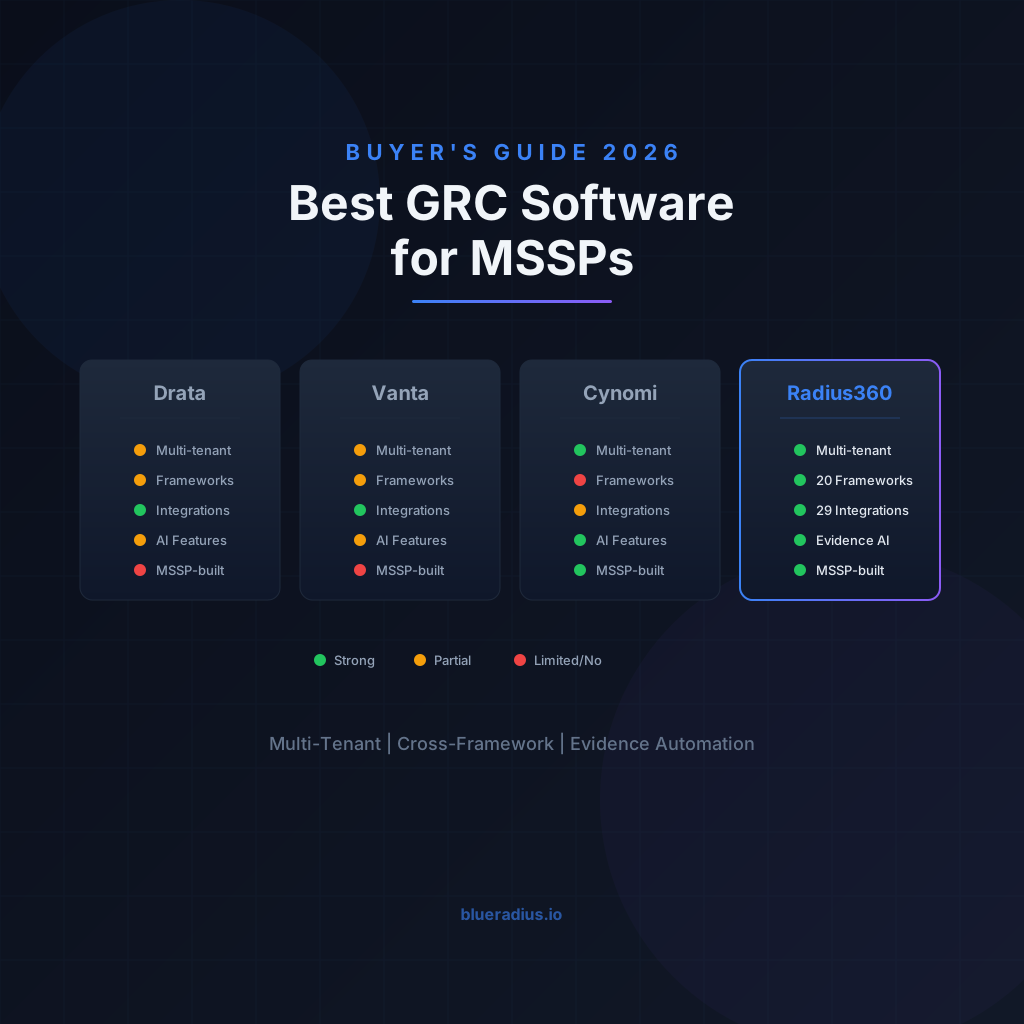
If you're an MSSP or vCISO managing compliance for multiple clients, you already know the pain: enterprise GRC platforms weren't built for you. They assume one company, one security team, one compliance program. But you're juggling 10, 20, maybe 50 clients — each with different frameworks, different maturity levels, and different board expectations.
In 2026, a new wave of GRC platforms is finally addressing this gap. Here's what to look for, what to avoid, and how the top contenders stack up.
Why Traditional GRC Tools Fail MSSPs
Most GRC platforms on the market — think ServiceNow GRC, Archer, or even newer players like Drata and Vanta — were designed for single-organization use. They solve the problem of "how does Company X manage its own compliance?"
That's a fundamentally different problem from what MSSPs face:
- Multi-tenancy — You need isolated environments per client with centralized visibility across all of them
- Cross-framework mapping — A client might need SOC 2, HIPAA, and NIST CSF simultaneously. Duplicating controls across frameworks is a time sink
- Evidence automation at scale — Manually collecting screenshots for 20 clients is not a business model
- White-label reporting — Your clients' boards don't want to see another vendor's logo on their risk report
- Per-client integrations — Each client has different cloud providers, identity systems, and endpoint tools
What to Look for in a GRC Platform for MSSPs
Based on what's working for managed security service providers in 2026, here are the non-negotiable features:
1. True Multi-Tenancy
Not "create a separate account per client" — actual multi-tenant architecture where you can switch between clients instantly, see aggregate dashboards, and manage team access at the tenant level. Row-level security should isolate client data completely while giving you a unified management plane.
2. Deep Integrations (Not Just Checkboxes)
Many platforms claim 100+ integrations but only pull surface-level metadata. What matters is deep integration — pulling actual configuration data, policy settings, and compliance evidence automatically. Look for platforms that integrate with:
- Cloud providers (AWS, Azure, GCP) for infrastructure compliance
- Identity providers (Okta, Azure AD, Google Workspace) for access reviews
- Endpoint tools (CrowdStrike, SentinelOne) for device compliance
- Code repositories (GitHub, GitLab) for SDLC controls
- HR systems for onboarding/offboarding evidence
3. Framework Coverage That Actually Maps
Supporting 20 frameworks on paper means nothing if controls don't map across them. When a client implements a control for SOC 2, that same evidence should automatically satisfy the corresponding NIST CSF and ISO 27001 requirements. This is where most platforms fall short — they treat each framework as a silo.
4. AI-Powered Workflows
In 2026, if your GRC platform doesn't use AI to accelerate policy generation, gap assessments, and board reporting, you're leaving money on the table. The best platforms now offer:
- AI policy generation that's evidence-aware — it knows what controls you have in place and tailors policies accordingly
- Automated gap assessments that identify exactly where a client falls short against a target framework
- Board report generation that turns raw compliance data into executive-ready narratives
5. Scheduled Syncs and Real-Time Monitoring
Evidence collection should run on a schedule — not just when someone remembers to click "sync." The best platforms let you configure per-integration sync schedules so compliance data stays current without manual intervention.
The 2026 Landscape: How Top Platforms Compare
| Feature | Drata | Vanta | Cynomi | Radius360 |
|---|---|---|---|---|
| Multi-tenant architecture | Limited | Limited | Yes | Yes (RLS) |
| Cross-framework mapping | Partial | Partial | No | 20 frameworks |
| Deep integrations | 75+ | 100+ | Limited | 13 deep + 16 standard |
| AI policy generation | Basic | Basic | Yes | Evidence-aware |
| Board report generator | No | No | Yes | AI-generated |
| Built for MSSPs/vCISOs | No | No | Yes | Yes |
| Pricing model | Per company | Per company | Per client | Per client tier |
A Closer Look at the Contenders
Drata
Drata has built a strong reputation for SOC 2 automation and has expanded into additional frameworks. However, it remains fundamentally a single-org tool. MSSPs using Drata typically need separate instances per client, which creates management overhead and makes cross-client reporting nearly impossible. It's excellent if you have one or two large clients — but it doesn't scale for a service provider managing a portfolio.
Vanta
Vanta offers the broadest integration library and has made strides in framework coverage. Like Drata, though, its architecture assumes a single organization. The "Vanta for MSPs" program helps with billing, but the underlying product still lacks true multi-tenancy. If your clients are primarily startup-stage companies doing their first SOC 2, Vanta is a reasonable choice. For complex, multi-framework environments, it starts to strain.
Cynomi
Cynomi is the closest competitor in the MSSP-focused space, offering AI-generated plans and multi-client management. Where it falls short is in deep technical integrations and cross-framework mapping. It's strong on the advisory/planning side but lighter on automated evidence collection from actual infrastructure.
Radius360
Radius360 was built from the ground up for MSSPs and vCISOs. Key differentiators:
- True multi-tenant architecture with row-level security — every client's data is fully isolated while you get a single management plane
- 20 compliance frameworks with intelligent cross-mapping, so implementing a control once satisfies it everywhere
- 13 deep integrations that pull actual compliance evidence (not just connection status) plus 16 standard integrations, all with configurable scheduled syncs
- Evidence-aware AI — policy generation, gap assessments, and board reports that understand your actual compliance posture, not generic templates
- Purpose-built pricing for service providers managing client portfolios, not per-seat enterprise pricing that punishes scale
How to Evaluate: A Quick Checklist
Before committing to a platform, run through this evaluation:
- Create two test tenants — Can you switch between them seamlessly? Can you see both from a single dashboard?
- Connect a real integration — Does it pull actual evidence, or just confirm a connection exists?
- Map one control across three frameworks — Does the platform handle this automatically, or do you need to duplicate work?
- Generate a board report — Is it something you'd actually put in front of a client's board, or does it need heavy editing?
- Check the pricing at scale — What happens to your bill when you go from 5 clients to 25?
The Bottom Line
The GRC market in 2026 is splitting into two lanes: enterprise tools (Drata, Vanta, ServiceNow) that serve large internal security teams, and service-provider tools (Radius360, Cynomi) that serve MSSPs and vCISOs managing portfolios of clients.
If you're a service provider, stop trying to make enterprise tools work. Choose a platform that was built for how you actually operate — multi-tenant, multi-framework, and designed to scale with your client base.
Need help building your compliance program? Get a free cybersecurity assessment from BlueRadius Cyber, or try Radius360 free — purpose-built GRC for MSSPs and vCISOs.
Related from the BlueRadius Library
Sourced posts on adjacent topics, ranked by tag overlap.
Managed Security
Managed Cybersecurity Services for Mid-Market Companies 2026
What mid-market companies (50-2,000 employees) need from managed cybersecurity services in 2026: coverage, pricing components, and where engagements fail.
ReadIndustry
How to Add a Cybersecurity Practice to Your MSP Without Hiring a CISO
How MSPs add a cybersecurity practice without hiring a full-time CISO: vCISO partnership model, revenue share, technology stack, and client onboarding.
ReadCompliance
ISO 27001 vs SOC 2: Which Compliance Framework Does Your Company Need? (2026)
ISO 27001 vs SOC 2 compared: certification vs attestation, the shared control core, how to choose, and whether to pursue both. A 2026 mid-market guide.
ReadLeadership
12 Questions to Ask Before Hiring a vCISO (2026)
Hiring a virtual CISO? Ask these 12 questions first, covering scope, frameworks, pricing, integration, references, and how to evaluate the answers.
ReadAI Security
Securing AI Agents: An Agentic AI Security Guide for 2026
An agentic AI security guide for mid-market: the agent attack surface, prompt injection, excessive agency, non-human identities, and a checklist.
ReadvCISO
Virtual CISO vs. Building an Internal Security Team in Dallas-Fort Worth: A Cost and Capability Analysis
Virtual CISO vs building an internal security team in Dallas-Fort Worth: cost comparison, capability analysis, and when each model makes sense.
ReadRelated services