Securing AI Agents: An Agentic AI Security Guide for 2026
AI agents do not just generate text, they take actions: calling APIs, moving money, changing systems. Here is the agentic AI attack surface and a practical control set for deploying agents safely in 2026.
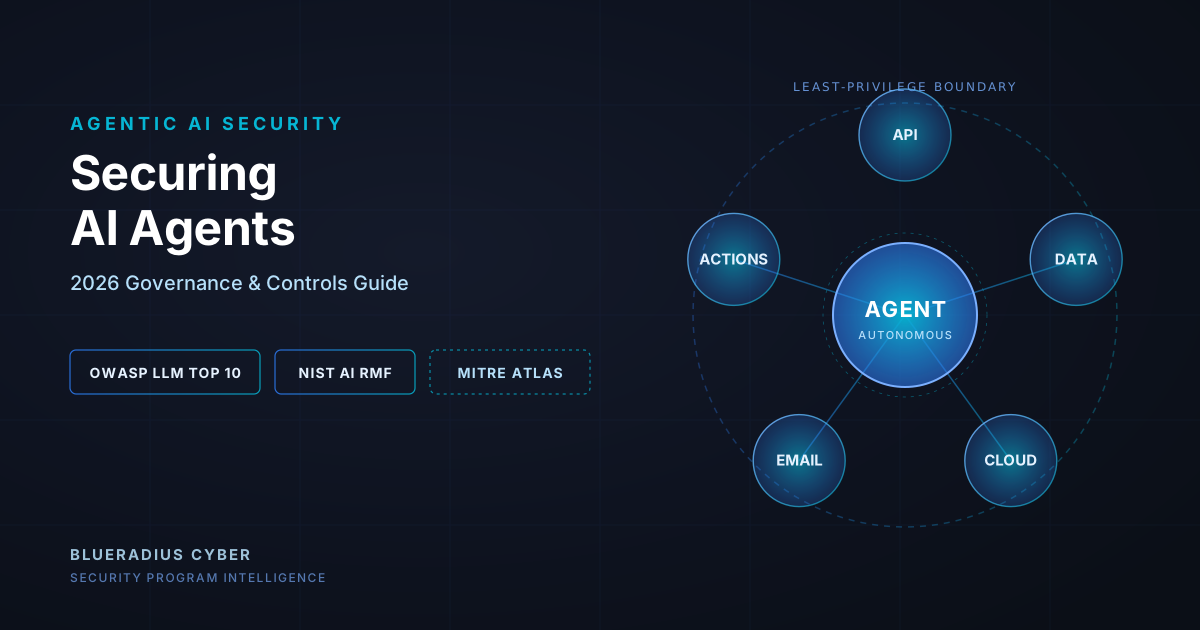
Securing AI Agents: An Agentic AI Security Guide for 2026
BlueRadius Cyber helps U.S. mid-market companies secure agentic AI, the class of AI systems that do not just generate text but take actions: calling APIs, executing code, moving money, querying databases, and chaining steps toward a goal with limited human oversight. Agentic AI security is the practice of governing what those agents are allowed to do, constraining the tools and data they can reach, and monitoring their behavior so an autonomous system cannot be hijacked into causing harm. As companies move from chat assistants to AI agents that act on their behalf, the security question shifts from "what can the model say" to "what can the model do," and most organizations have no controls for the second question.
This is the fastest-moving risk surface in enterprise security right now. An AI agent with access to your tools is, in effect, a new kind of privileged user: one that can be manipulated through its inputs, that operates faster than any human, and that rarely appears in your identity or access governance. This guide explains the agentic attack surface, the frameworks that map it, and a practical control set mid-market companies can put in place before they deploy agents into production.
Why Agents Are a Different Security Problem Than Chatbots
A standard large-language-model chatbot has a contained blast radius: the worst case is usually a bad answer. An agent removes that containment. Give a model the ability to call tools and it can read your CRM, send email as your domain, open pull requests, issue refunds, or change cloud configurations. Three properties make agents uniquely dangerous:
- Autonomy: agents take multi-step actions without a human approving each one, so a single manipulated instruction can cascade through several real operations before anyone notices.
- Tool access: the value of an agent comes from the systems it can reach, which means its privileges, and its potential for damage, scale with its usefulness.
- Untrusted input as control flow: an agent reads web pages, documents, and emails, and any of that content can contain instructions. The boundary between data and command, which traditional applications enforce, is blurred by design.
The Agentic AI Attack Surface
The security community has converged on a recognizable set of agent-specific threats. The OWASP Top 10 for LLM Applications and OWASP's agentic threat work, NIST's AI Risk Management Framework, and the MITRE ATLAS knowledge base all describe variants of the following.
Prompt injection and tool misuse
The defining agent vulnerability. An attacker plants instructions in content the agent will process, a web page, a support ticket, a PDF, a calendar invite, and the agent follows them. Indirect prompt injection can turn a benign summarization task into a data-exfiltration or unauthorized-action event because the agent cannot reliably tell your instructions from an attacker's.
Excessive agency
Agents are routinely granted more capability, permission, or autonomy than the task requires: broad API scopes, write access where read would do, the ability to act without confirmation. Excessive agency converts a minor manipulation into a major incident. The mitigation is least privilege applied to the agent's tools, not just its user account.
Identity and non-human credentials
Agents authenticate to systems using API keys, service accounts, and OAuth tokens that frequently live outside your identity governance. These non-human identities often have standing, over-broad access and no lifecycle. An agent's credentials are now one of the most attractive targets in your environment, and one of the least monitored. Bring them under the same access review discipline you apply to people, a discipline our AI vendor risk assessment framework extends to third-party agents.
Memory and context poisoning
Agents that retain memory across sessions or share a knowledge store can be poisoned: an attacker plants false context once, and the agent acts on it repeatedly. This persistence makes memory a high-value target distinct from a single-turn prompt attack.
Supply chain and tool integrity
Agents depend on models, plugins, tool definitions, and increasingly on external connectors and protocols. A compromised or spoofed tool, or a malicious connector the agent is allowed to discover and use, can redirect the agent's actions. This is the AI-era extension of the software supply-chain problem covered in our broader work on shadow AI.
The Agentic AI Security Readiness Checklist
Put these controls in place before agents reach production, then sustain them as the deployment grows.
Inventory every agent and its capabilities
Maintain a register of every AI agent in use, what tools and data each can reach, what actions each can take, and who owns it. You cannot govern agents you cannot see, and shadow agents spun up by individual teams are already common.
Apply least privilege to tools, not just users
Scope each agent's API access, database permissions, and tool set to the minimum its task requires. Prefer read access over write, scoped tokens over broad ones, and per-agent credentials over shared keys so that one compromised agent cannot reach the whole environment.
Put humans in the loop for high-impact actions
Require explicit human approval for irreversible or high-value operations: moving money, deleting data, sending external communications, changing production configuration. Reserve full autonomy for low-risk, easily reversible tasks.
Treat all agent input as untrusted
Assume any content an agent ingests may contain injected instructions. Isolate and sanitize tool outputs, constrain what fetched content can trigger, and design tools so that data retrieved by the agent cannot silently escalate into new privileged actions.
Govern non-human identities
Bring agent credentials into identity governance: short-lived tokens, scoped permissions, rotation, and inclusion in access reviews. Monitor for anomalous agent behavior the way you monitor privileged human accounts, through your threat operations pipeline.
Log, monitor, and constrain agent behavior
Record every tool call, decision, and action an agent takes, with enough context to reconstruct an incident. Set rate limits and spending or action caps so a runaway or hijacked agent has a hard ceiling on the damage it can do before a human intervenes.
Map agent risk to a recognized framework
Anchor the program to the NIST AI Risk Management Framework and the OWASP LLM and agentic threat lists so your controls map to an external standard auditors and customers recognize. Our NIST AI RMF implementation guide walks through that mapping.
Governance: Where Agentic AI Security Fits
Agentic AI security is not a standalone tool purchase; it is an extension of your existing AI governance and security architecture. The agent register belongs in the same inventory as your AI models and AI vendors. Agent permissions belong in the same access-governance program as human identities. Agent risk belongs in the same risk register your virtual CISO already maintains. Companies that bolt agent security on as an afterthought end up with ungoverned automation reaching production; companies that fold it into an existing AI governance program deploy agents faster because the guardrails are already defined.
Regulatory pressure is moving in the same direction. The EU AI Act's obligations around high-risk and autonomous systems, covered in our EU AI Act compliance guide, increasingly touch systems that act, not just systems that predict. Building agent governance now is the cheaper path than retrofitting it under a compliance deadline.
Frequently Asked Questions
What is agentic AI, and how is it different from a chatbot?
Agentic AI refers to AI systems that take actions toward a goal rather than only producing text. A chatbot answers a question; an agent can read a system, decide on a next step, call a tool or API to execute it, observe the result, and continue, often across multiple steps with limited human oversight. The security difference is the blast radius: a chatbot's worst case is usually a bad answer, while an agent can move money, change data, or send communications, which makes governing its permissions and inputs a real security control rather than a content concern.
What is the biggest security risk with AI agents?
Prompt injection combined with excessive agency. An attacker plants instructions in content the agent processes, a web page, a document, an email, and if the agent has broad tool access and the ability to act without confirmation, that single manipulation can cascade into data exfiltration or unauthorized actions. The defense is layered: treat all agent input as untrusted, scope each agent's tools to least privilege, and require human approval for high-impact operations.
How do I secure the credentials an AI agent uses?
Treat agent credentials as non-human identities under the same governance you apply to privileged users. Use short-lived, scoped tokens rather than long-lived broad API keys, give each agent its own credentials instead of sharing keys, rotate them on a schedule, and include them in access reviews. Then monitor agent activity for anomalies the way you would a privileged account, because a compromised agent credential is one of the highest-value targets in an environment that deploys agents.
Which frameworks cover agentic AI security?
The most useful reference points are the OWASP Top 10 for LLM Applications and OWASP's agentic AI threat work for the threat taxonomy, the NIST AI Risk Management Framework for program structure and governance, and the MITRE ATLAS knowledge base for adversary techniques against AI systems. Mapping your agent controls to these gives you a defensible, externally recognized program rather than an ad hoc one.
Can a virtual CISO help us deploy AI agents safely?
Yes. A fractional virtual CISO typically owns the agent governance program: building the agent inventory, setting least-privilege standards for tools and credentials, defining which actions require human approval, mapping controls to the NIST AI RMF, and folding agent risk into the broader AI governance and risk register. For mid-market companies adopting agents faster than they can staff for the risk, that fractional model is how the guardrails get built without slowing the rollout.
If your teams are already experimenting with AI agents, and most are, whether security knows it or not, start with an inventory and a least-privilege baseline. A focused cybersecurity assessment will surface the agents already in your environment and turn unmanaged automation into a governed capability.
Related from the BlueRadius Library
Sourced posts on adjacent topics, ranked by tag overlap.
AI Security
NIST AI Risk Management Framework: A 2026 Implementation Guide
The NIST AI Risk Management Framework explained: the four functions (Govern, Map, Measure, Manage), the Generative AI Profile, and an adoption path.
ReadAI Security
Bay Area AI Security & Governance: Protecting ML Models and Training Data
Bay Area AI companies need security governance for ML models, training data, and pipelines. Protect IP and meet emerging AI compliance requirements.
ReadAI Security
Shadow AI: The Biggest Security Risk Your Company Isn't Tracking
Shadow AI, employees using unapproved AI tools, is the fastest-growing security risk for mid-market companies. Learn to detect, assess, and manage it.
ReadAI Security
AI Vendor Risk Assessment: Questions Your CISO Should Be Asking
An AI vendor risk assessment framework with specific questions CISOs should ask about data handling, model transparency, and security controls.
ReadLeadership
12 Questions to Ask Before Hiring a vCISO (2026)
Hiring a virtual CISO? Ask these 12 questions first, covering scope, frameworks, pricing, integration, references, and how to evaluate the answers.
ReadCompliance
PCI DSS 4.0.1 Compliance: A Mid-Market Guide for 2026
A PCI DSS 4.0.1 compliance guide for mid-market companies: merchant levels, SAQ selection, what changed in 4.0, and a step-by-step readiness checklist.
ReadRelated services