12 Questions to Ask Before Hiring a vCISO (2026)
Before you hire a vCISO, ask these 12 questions about scope, frameworks, pricing, and references. A practical vetting checklist for mid-market leaders.
12 Questions to Ask Before Hiring a vCISO (2026)
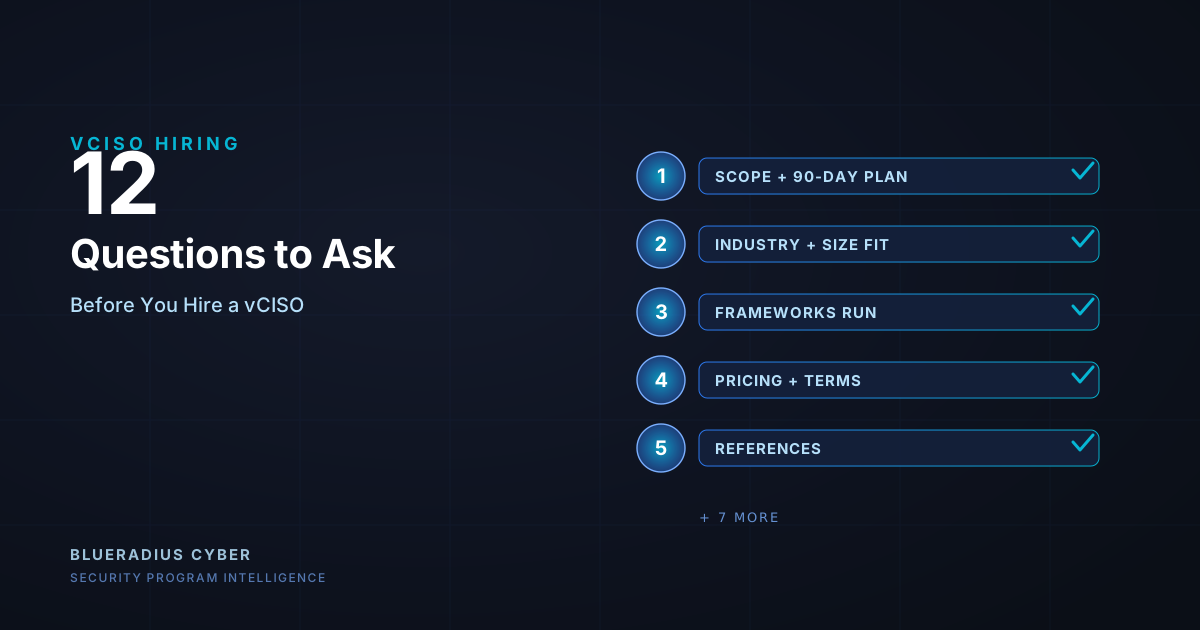
Before hiring a virtual CISO, ask these 12 questions to confirm the firm can scope your program, run your frameworks, report to your board, and transfer knowledge cleanly; BlueRadius Cyber publishes them because most failed vCISO engagements trace back to questions that were never asked during evaluation, not to a lack of technical skill. The title is unregulated, engagement models vary widely, and the gap between a senior security operator and a thinly staffed reseller is hard to see from a sales deck. Use them in your first or second conversation, take notes, and compare vendors side by side.
1. How will you scope our security program in the first 90 days?
The first quarter sets the trajectory of the engagement, so a credible vCISO should describe a structured method rather than promising to "dig in and see." Look for a current-state assessment, stakeholder interviews, an inventory of systems and data, a gap analysis against a relevant framework, and a prioritized roadmap with owners and dates, all tied to business risk rather than a checklist.
If the vCISO asks about your revenue model, customers' security demands, and regulatory exposure before proposing a plan, that is a good sign; vague or one-size-fits-all answers are a warning. Compare this to how our team approaches engagements on our virtual CISO services page.
2. What experience do you have with companies in our industry and at our size?
Security priorities differ sharply between a small SaaS startup and a mid-sized healthcare firm. A vCISO who has only worked with enterprises may over-engineer your program, while one who has only served startups may underestimate your regulatory and procurement pressures. Ask for examples of companies similar to yours in headcount, industry, and data sensitivity.
A strong answer names the patterns they have seen in your segment, the controls that mattered most, and the mistakes companies your size tend to make. Generic claims of "deep experience across all verticals" deserve follow-up.
3. Which compliance frameworks do you actually run, and how often?
Many firms list every framework on their website but operate only one or two in practice. You want a vCISO who has personally led the frameworks you care about, whether SOC 2, ISO 27001, HIPAA, PCI DSS, or CMMC, and who can speak to the auditor relationships and evidence demands of each. Reading a framework and steering a company through an audit are very different things.
A strong answer distinguishes frameworks they run routinely from ones they support occasionally, and sets honest expectations about timelines. If you are targeting an attestation, review how it maps to your obligations on our regulatory compliance overview and, for SOC 2 specifically, our SOC 2 compliance services page.
4. How will you report to our board and executive team?
A vCISO who cannot translate technical risk into language a board understands will struggle to get budget approved and decisions made. Ask to see a sample board report or a description of their executive reporting; cadence, format, and metrics all matter.
A strong answer shows risk framed in business terms, trend lines rather than snapshots, and recommendations tied to dollars and timelines. Reporting that is mostly raw vulnerability counts signals a practitioner rather than a security leader, and board fluency is a primary reason companies hire a vCISO.
5. How do you integrate with an internal team or an existing MSSP?
A vCISO rarely works in isolation. You may have an internal IT team, a security analyst, or a managed security service provider already handling monitoring and response, and the vCISO needs to direct that ecosystem, not duplicate or fight it. Ask how they define roles, hand off work, and hold partners accountable.
A strong answer describes the vCISO as the strategy and governance layer that sets priorities while the MSSP and internal staff execute, with a clear view of who owns detection, remediation, and the roadmap. Our vCISO and MSSP integration guide covers how these responsibilities are best divided.
6. Is your pricing transparent, and what are the contract terms?
Pricing opacity and aggressive lock-in are two of the most common sources of buyer regret. Ask what is included, what counts as out of scope, and how change requests are handled. Just as important, ask about contract length and exit terms, and be cautious of multi-year commitments that are hard to leave.
As a market range, vCISO pricing tends to run roughly $6,000 to $15,000 per month for growth-stage companies and $15,000 to $25,000 per month for mid-market organizations, framed here as a market range rather than a quote for any specific scope. A strong vendor explains how its pricing maps to deliverables and offers reasonable terms, including a defined ramp and off-ramp. Read more on our vCISO cost page, and question any multi-year lock-in that lacks an off-ramp.
7. What is your role in incident response and escalation?
When a security incident hits, ambiguity about who does what costs time you do not have. Ask what the vCISO does during an incident, how quickly they are reachable, and where the line sits between their responsibilities and your team's or MSSP's. A vCISO is usually the incident commander and executive communicator, not the hands-on responder, but that division must be explicit.
A strong answer references a tested incident response plan, defined escalation paths, and a communications protocol for executives, customers, and regulators. If the vCISO treats response as an afterthought or assumes the MSSP has it covered, press for specifics.
8. What concrete deliverables will we receive, and on what cadence?
An engagement built on availability alone is hard to evaluate and easy to let drift. Ask for tangible deliverables: the security roadmap, policies and standards, risk register, board reports, audit readiness artifacts, and a defined meeting cadence so you know what lands on your desk monthly and quarterly.
A strong answer commits to specific artifacts and a predictable rhythm. Vague promises of "ongoing advisory support" without defined outputs make it hard to know whether you are getting value or simply paying a retainer.
9. Can you provide references from comparable companies?
References are one of the most reliable signals available, and a confident vCISO offers them without hesitation. Ask to speak with current or recent clients that resemble your company in size, industry, and goals, then ask pointed questions about responsiveness, follow-through, and how the relationship handled stress.
A strong answer connects you with references quickly and encourages candid conversations. Reluctance, filtered references, or being offered only logos rather than live calls should give you pause. The best references tell you not just that the vCISO is competent, but how they behave when a deadline slips.
10. How do you measure whether the program is succeeding?
Security can feel like a cost center with no obvious finish line, so a good vCISO defines what progress looks like and tracks it. Ask which metrics they use, how they baseline them, and how they show improvement over time; reduced risk, closed audit gaps, shorter remediation times, and improving control maturity are all measurable.
A strong answer ties metrics to business outcomes such as winning deals that require attestations, reducing the impact of incidents, or satisfying regulators. Beware of measurement that fixates on activity rather than risk reduction. The goal is a program that demonstrably lowers your exposure, not one that simply stays busy.
11. How will you handle knowledge transfer and offboarding?
Every vCISO engagement ends eventually, whether you hire a full-time CISO, change vendors, or graduate to a different model. A professional vCISO plans for that from the start by documenting decisions, keeping your policies and risk register in systems you own, and keeping institutional knowledge accessible to your team.
A strong answer treats your security program as your asset, not theirs: clean handoffs, owned-by-you documentation, and a transition plan that does not leave you stranded. A vendor who makes offboarding deliberately painful is protecting its retention numbers, not your interests.
12. How do you maintain independence and avoid conflicts of interest?
Some firms that sell vCISO services also resell tools, MSSP contracts, or audit services, which can bias recommendations toward products that pay them. Ask whether the vCISO earns commissions or referral fees on what they recommend, and how they keep advice independent of those incentives.
A strong answer is transparent about any partnerships and explains how recommendations are made on the merits. The value of a vCISO is trusted judgment; if their advice is quietly tied to a sales motion, you lose the objectivity you are paying for. You do not need a vendor with zero partnerships, only one that discloses them and puts your interests first.
How to Evaluate the Answers
Score each vendor on substance, not polish. The strongest vCISOs answer with specifics: named frameworks they personally run, real examples from companies like yours, clear deliverables, and honest trade-offs. The weakest hide behind buzzwords, dodge questions about pricing and terms, and resist references. Pay particular attention to independence, offboarding, and lock-in, because those reveal whose interests the engagement is designed to serve.
Compare answers across vendors side by side rather than relying on impressions. Watch for consistency: a vendor whose roadmap, reporting, and metrics all reinforce the same business outcomes has usually done this before. When you are ready to test a real conversation against this list, begin with a free cybersecurity assessment to ground the discussion in your actual gaps rather than a generic pitch.
Frequently Asked Questions
When does it make sense to hire a vCISO instead of a full-time CISO?
A vCISO usually makes sense when you need senior security leadership but cannot justify or attract a full-time executive, which is common for mid-market and growth-stage companies. You get board-level strategy, framework expertise, and program governance on a fractional basis, and a good vCISO helps you plan the eventual transition to an internal hire through clean knowledge transfer.
How much does a vCISO cost?
vCISO pricing varies with scope, frameworks, and program maturity. As a market range, growth-stage engagements often fall between $6,000 and $15,000 per month, and mid-market engagements between $15,000 and $25,000 per month. Evaluate cost by mapping it to defined deliverables and outcomes. Our vCISO cost page explains the factors that drive pricing.
Can a vCISO work alongside our existing MSSP or internal IT team?
Yes, and the best engagements are built that way. A vCISO sets strategy, priorities, and governance while your MSSP and internal staff handle monitoring, remediation, and day-to-day operations. The key is defining roles so responsibilities do not overlap or fall through gaps. Our vCISO and MSSP integration guide describes how to divide them effectively.
Which compliance frameworks can a vCISO help us achieve?
A capable vCISO can lead programs for SOC 2, ISO 27001, HIPAA, PCI DSS, and CMMC, depending on your industry and customer requirements. Confirm the firm actively runs the frameworks you need, not just lists them. Review how these obligations apply on our regulatory compliance page.
What should I watch out for in a vCISO contract?
Watch for multi-year lock-in with no performance off-ramp, vague scope that invites surprise charges, opaque pricing, and offboarding terms that make it hard to leave with your own documentation. Insist on transparent pricing, defined deliverables, and a clean exit path; a vendor confident in its value offers reasonable terms rather than relying on contractual friction.
Related from the BlueRadius Library
Sourced posts on adjacent topics, ranked by tag overlap.
vCISO
Virtual CISO vs. Building an Internal Security Team in Dallas-Fort Worth: A Cost and Capability Analysis
Virtual CISO vs building an internal security team in Dallas-Fort Worth: cost comparison, capability analysis, and when each model makes sense.
ReadCompliance
PCI DSS 4.0.1 Compliance: A Mid-Market Guide for 2026
A PCI DSS 4.0.1 compliance guide for mid-market companies: merchant levels, SAQ selection, what changed in 4.0, and a step-by-step readiness checklist.
ReadManaged Security
Managed Cybersecurity Services for Mid-Market Companies 2026
What mid-market companies (50-2,000 employees) need from managed cybersecurity services in 2026: coverage, pricing components, and where engagements fail.
ReadLeadership
12 Cybersecurity Questions Every Board Should Ask (2026)
The 12 cybersecurity questions every board should ask management: top risks, ransomware, SEC disclosure, vendor risk, IR readiness, and AI governance.
ReadLeadership
The I-35 Cybersecurity Gap: Why Central Texas Businesses Between Austin and Dallas Are Underserved
Central Texas businesses between Austin and Dallas lack dedicated cybersecurity providers. Why the I-35 corridor needs real security leadership.
ReadManaged Security
Incident Response Tabletop Exercises: A 2026 Guide to IR Drills
How to run incident response tabletop exercises: exercise types, who attends, common scenarios, the six-phase IR lifecycle, and a readiness checklist for 2026.
ReadRelated services