Incident Response Tabletop Exercises: A 2026 Guide to IR Drills
Incident response tabletop exercises find the gaps in your IR plan before a real attacker does. Here are the exercise types, scenarios, and a step-by-step readiness checklist.
Incident Response Tabletop Exercises: A 2026 Guide to IR Drills
BlueRadius Cyber defines an incident response tabletop exercise as a structured, discussion-based drill in which a security team and business leaders walk through a simulated cyber incident, step by step, to test how their incident response plan, decisions, and communications would hold up under real pressure. Unlike a live technical test, a tabletop is conducted around a table (physical or virtual): a facilitator presents a realistic scenario, participants describe what they would actually do at each stage, and the gaps that surface become a prioritized list of fixes before an attacker forces them. For mid-market companies, tabletops are among the highest-leverage, lowest-cost security investments available, and auditors and insurers increasingly expect them.
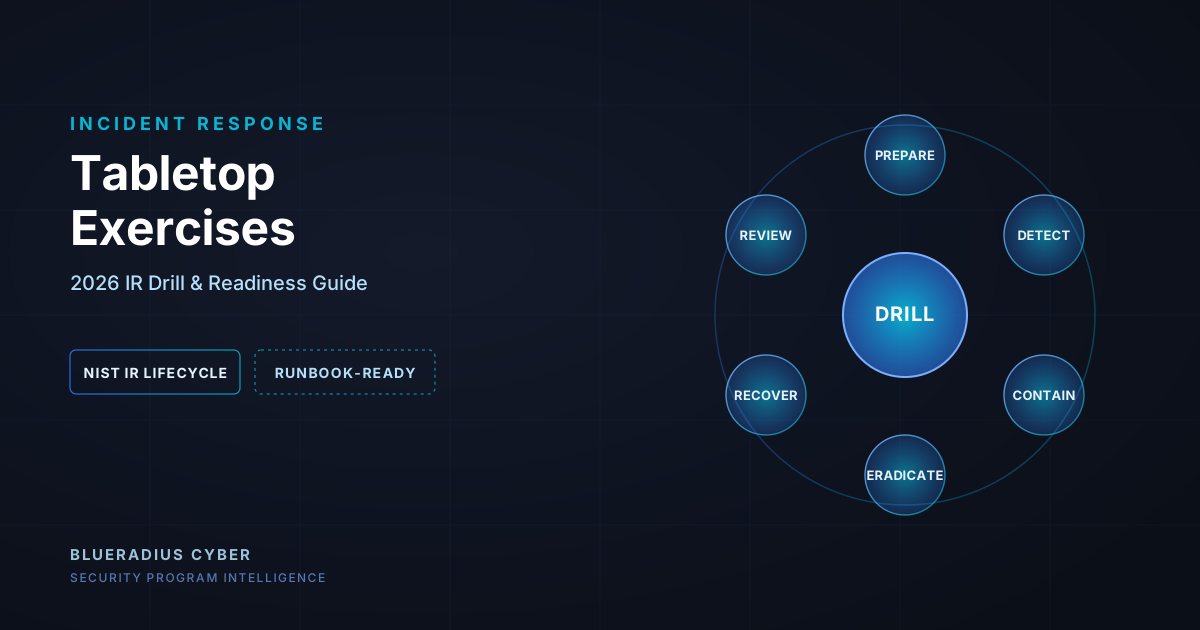
This guide explains what a tabletop exercise is, why it matters, the types of drills, who belongs in the room, the scenarios worth rehearsing, and how the six-phase incident response lifecycle gives every exercise a repeatable backbone. It is written for leaders who want a program they can run with confidence, internally or with a partner offering incident response services in Texas.
What a Tabletop Exercise Actually Is
A tabletop exercise is a guided conversation built around a plausible incident. A facilitator, often a vCISO or incident commander, introduces a scenario such as a ransomware note on a finance server, then releases information in stages called injects that force decisions in sequence: Who do we call first? When do we isolate affected systems? Who approves taking a customer-facing service offline, and do we notify regulators?
The point is not a perfect performance; it is to surface the moments where people hesitate, where ownership is unclear, or where a runbook is missing. Discomfort in a conference room is far cheaper than confusion during a live breach, which is why tabletops and effective data breach incident response planning are two halves of the same discipline.
Why Tabletop Exercises Matter
Find the gaps before a real incident does
Most incident response plans look complete on paper and fall apart at first contact with reality. A tabletop reveals the unglamorous failure points: an out-of-date contact list, an escalation path that depends on someone on vacation, a backup never tested for restoration, or a legal review step nobody knew was required. Finding these in a drill prevents a future crisis.
Build muscle memory and clear decision rights
Teams that have rehearsed move faster under pressure because the roles, sequence, and decision authority are already familiar. Tabletops also clarify who can make the hard calls, such as paying or refusing a ransom, disclosing to customers, or pulling a system offline. Settling those decision rights in advance makes the live response calmer.
Satisfy auditors and cyber-insurance expectations
Regulators, frameworks, and underwriters increasingly expect evidence that an organization tests its incident response capability, not just that it owns a plan. A documented tabletop with an attendee list, scenario, captured findings, and remediation owners demonstrates maturity during an audit or insurance renewal. Many controls examiners check map directly to what a tabletop exercises, so this work supports broader regulatory compliance efforts.
Types of Exercises: Tabletop, Functional, and Full-Scale
Not every drill needs to be elaborate. Choosing the right format for your maturity and budget keeps the program sustainable.
- Tabletop exercise: A discussion-based walkthrough. No systems are touched and no production impact occurs; participants talk through their actions while a facilitator drives the scenario. This is the best starting point for almost every mid-market organization: low risk, low cost, and high in learning value.
- Functional exercise: A hands-on drill in which specific functions are performed in a controlled way, such as executing a backup restoration, triggering an alert, or revoking a compromised credential. It validates that a capability works, not just that someone can describe it.
- Full-scale exercise: A live, end-to-end simulation that mobilizes people, tools, and processes as if the incident were real. These are resource-intensive and usually reserved for mature programs, after several successful tabletops and functional tests.
A practical maturity path is to run tabletops consistently, layer in functional tests for your highest-risk capabilities such as backup recovery, and consider a full-scale exercise once the basics are reliable. A partner providing managed security support can operate the functional and live components an internal team may lack the capacity to run.
Who Should Attend
A tabletop is only as useful as the people in the room. The most common reason a drill underperforms is that it is treated as an IT-only event, when incidents are business events.
- Executive leadership: A senior decision-maker who can authorize spending, approve disclosure, and own the business risk. Without them, the exercise cannot test the decisions that matter most.
- Legal and privacy: Counsel who can speak to breach-notification obligations, regulatory timelines, contractual duties, and privileged communications.
- Communications and marketing: The people who draft customer messaging and manage media inquiries. Poor communication can do more lasting damage than the technical incident itself.
- IT and security: The responders who contain, investigate, and recover, and who identify what is realistically possible under pressure.
- Human resources: Essential when an incident involves an insider, employee data, or personnel actions, and often the owner of internal communications.
Depending on the scenario, finance, customer success, and a third-party forensics or incident response partner may also belong in the room. When an exercise points toward evidence preservation and root-cause analysis, this digital forensics executive guide for post-breach situations shows what an investigation requires.
Common Scenarios Worth Rehearsing
Strong scenarios are specific, plausible, and tailored to your environment. These five cover the threats most mid-market organizations face.
- Ransomware: Files are encrypted and a ransom demand arrives. Stresses backup integrity, payment decision authority, regulatory notification, and the ability to operate while systems are down.
- Business email compromise: An attacker takes over or spoofs a finance mailbox to redirect a wire transfer. Tests financial controls, out-of-band verification, and how quickly a fraudulent request is caught.
- Data breach: Sensitive customer or employee records are confirmed exfiltrated. Drives the notification clock, legal review, customer communications, and privacy obligations.
- Third-party or vendor compromise: A breach originates with a supplier, MSP, or vendor that has access to your environment. Rehearses vendor coordination, contractual leverage, and the limits of your visibility into someone else's systems.
- Cloud account takeover: An attacker gains control of a privileged cloud or identity account. Tests cloud detection, credential revocation, multi-factor enforcement, and tracing what the attacker touched.
The Six-Phase Incident Response Lifecycle as the Backbone
Every well-run tabletop follows the incident response lifecycle, because a real incident does the same. Using the six phases as the spine ensures nothing is skipped.
Prepare
Everything done before an incident: the plan, runbooks, contact lists, tooling, and training. A tabletop is itself a preparation activity, and many findings trace back to a preparation gap.
Detect and Identify
How the incident is first noticed and confirmed. The exercise probes what signals exist, who is watching them, and how a suspicion becomes a declared incident with an owner.
Contain
Stopping the spread. Participants decide what to isolate, when, and who approves disruptive actions, balancing speed against evidence.
Eradicate
Removing the attacker's foothold: malicious accounts, persistence mechanisms, and the root cause. This phase reveals whether the team can be confident the threat is truly gone.
Recover
Restoring operations safely, validating that systems are clean, and watching for the attacker's return. Backup restoration is a frequent stress point.
Review and Lessons Learned
The phase teams most often skip and most need. A structured debrief turns the incident into durable improvements to the plan, the controls, and the next exercise.
The Tabletop Exercise Readiness Checklist
Use these steps to plan and run a tabletop that produces real change rather than a box-checking exercise.
Define objectives and scope
Decide what you are trying to learn and where the boundaries sit. A focused objective, such as testing your ransomware decision rights or breach-notification timeline, produces sharper findings than a vague goal of testing the plan.
Assemble the right participants
Invite the cross-functional group the scenario demands: executive leadership, legal, communications, IT and security, and HR, plus finance or vendors where relevant. A tabletop without real authority cannot test the decisions that matter.
Build a realistic scenario with injects
Craft a scenario grounded in your actual environment, then prepare a sequence of injects that reveal new information over time. Good injects force pivots: a journalist calls, a regulator asks a question, or a second system goes down.
Run the exercise and capture decisions
Facilitate with a neutral driver and a dedicated scribe, and capture the decisions made, the questions raised, and the moments of hesitation. That record drives the follow-up.
Document gaps and action items
Convert what you observed into a prioritized list of specific gaps, each with a named owner and target date. A gap without an owner survives to the next drill.
Update the IR plan and runbooks
Feed the findings back into the incident response plan, the runbooks, the contact lists, and the escalation paths. The exercise only pays off if the plan responders rely on is measurably better afterward.
Set a recurring cadence
Treat tabletops as a program, not a one-time event. Set a regular schedule, rotate the scenarios, and revisit prior action items at the start of each session.
Where a vCISO Fits
Many mid-market organizations want to run tabletops but lack a senior incident commander to facilitate them credibly, which makes this a natural fit for fractional leadership. A virtual CISO service can own the exercise calendar, write scenarios tuned to your risk profile, facilitate sessions, and drive action items to closure, without a full-time hire. As a market reference, vCISO engagements commonly range from roughly $6,000 to $15,000 per month for growth-stage companies and $15,000 to $25,000 per month for mid-market organizations, with scope driving where each engagement lands. Between exercises, managed security monitoring keeps detection sharp.
Frequently Asked Questions
How often should we run a tabletop exercise?
A recurring cadence matters more than any single number. Run tabletops on a regular schedule and rotate the scenario each time. Auditors and cyber-insurance carriers want a consistent, documented rhythm rather than a one-off event, so set a schedule you can sustain.
How long does a tabletop exercise take?
A focused tabletop is typically a single facilitated session within a normal meeting block, plus preparation and follow-up time. Functional and full-scale exercises take longer, but a discussion-based tabletop is achievable without disrupting operations.
What is the difference between a tabletop and a penetration test?
A penetration test probes your technology for exploitable weaknesses. A tabletop tests your people, decisions, and processes. They are complementary: the pen test finds technical holes, while the tabletop reveals whether your team could respond once a hole is exploited.
Do we need to involve executives and legal, or can IT run it alone?
Real incidents are business events, so an IT-only drill misses the decisions that matter most: disclosure, regulatory notification, customer communication, and spending authority. Including executive leadership, legal, and communications makes it a true test of organizational readiness.
What should we do with the findings after the exercise?
Convert every gap into a specific action item with a named owner and a due date, then update your incident response plan and runbooks. Revisit those items at the start of your next exercise. Many mid-market teams bring in an external facilitator or incident response partner to run the exercises.
Related from the BlueRadius Library
Sourced posts on adjacent topics, ranked by tag overlap.
Managed Security
Managed Cybersecurity Services for Mid-Market Companies 2026
What mid-market companies (50-2,000 employees) need from managed cybersecurity services in 2026: coverage, pricing components, and where engagements fail.
ReadCompliance
SEC Cybersecurity Disclosure Rules: What Mid-Market Companies Need to Know in 2026
How SEC cybersecurity disclosure rules affect mid-market companies. Four-day reporting, board oversight, and what to prepare now.
ReadManaged Security
San Antonio Military Base Cybersecurity: Protecting Defense Operations
Cybersecurity for San Antonio military and defense contractors. Protect operations supporting JBSA, Fort Sam Houston, and Lackland AFB.
ReadManaged Security
Cleveland Manufacturing OT Cybersecurity: Protecting Industrial Control Systems
Protect Cleveland manufacturing with OT cybersecurity. Secure SCADA, PLCs, and industrial control systems from threats targeting Ohio manufacturers.
ReadCompliance
ISO 27001 vs SOC 2: Which Compliance Framework Does Your Company Need? (2026)
ISO 27001 vs SOC 2 compared: certification vs attestation, the shared control core, how to choose, and whether to pursue both. A 2026 mid-market guide.
ReadLeadership
12 Questions to Ask Before Hiring a vCISO (2026)
Hiring a virtual CISO? Ask these 12 questions first, covering scope, frameworks, pricing, integration, references, and how to evaluate the answers.
ReadRelated services