ISO 27001 vs SOC 2: Which Compliance Framework Does Your Company Need? (2026)
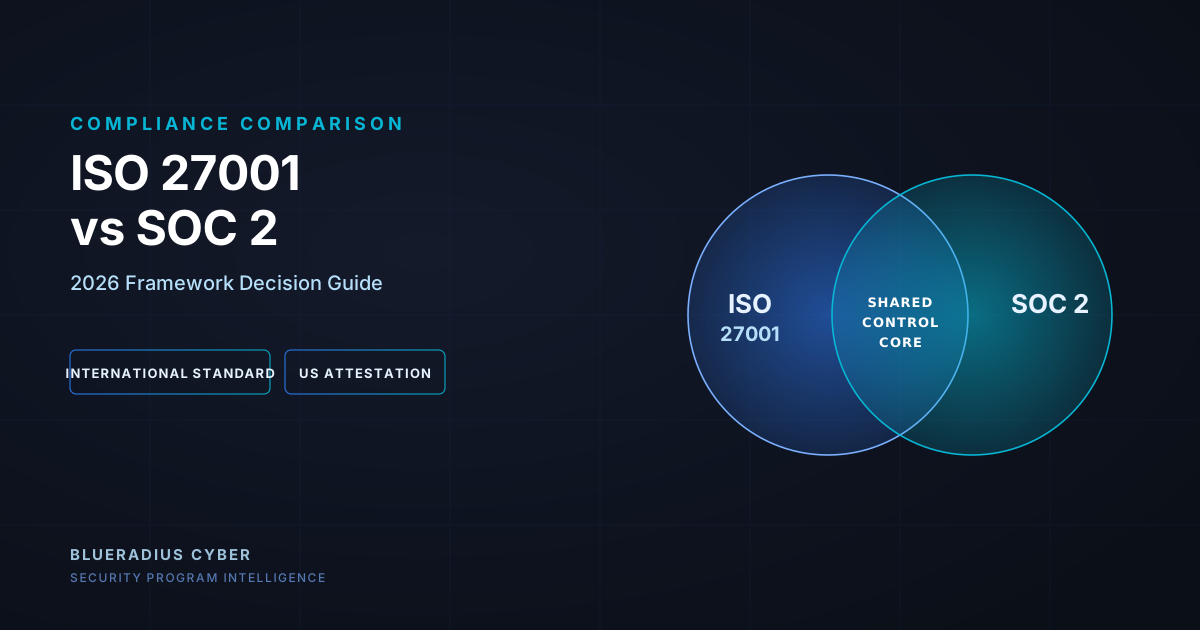
ISO 27001 vs SOC 2: one is an international certification, the other a US attestation, and they share a large control core. Here is how to choose, and whether to pursue both.
ISO 27001 vs SOC 2: Which Compliance Framework Does Your Company Need? (2026)
BlueRadius Cyber helps mid-market security and business leaders see the core difference clearly: ISO 27001 is an internationally recognized certification of a formally managed information security program, while SOC 2 is a US-centric attestation report in which an independent CPA firm evaluates your controls against the AICPA Trust Services Criteria. Both prove you take security seriously, but they speak to different audiences, produce different deliverables, and are driven by different commercial pressures. Choosing the right one, or deciding to pursue both, comes down to who your customers are, where they operate, and what they demand in contracts and security reviews.
This guide breaks down what each framework is, where they overlap and diverge, and how to make a defensible decision without burning budget on the wrong path. For a deeper walkthrough of either standard, our ISO 27001 certification guide and SOC 2 compliance services pages go further into the specifics.
What ISO 27001 Is
ISO 27001 is the leading international standard for information security management. Published jointly by the International Organization for Standardization and the International Electrotechnical Commission, it defines the requirements for an Information Security Management System, commonly shortened to ISMS. The ISMS is the heart of the standard: a documented, risk-driven system of policies, processes, roles, and controls that you operate continuously and improve over time.
An accredited certification body audits your ISMS, and if you pass, you receive a certificate recognized across most of the world, with particular weight in Europe, the United Kingdom, the Middle East, Asia, and increasingly North America. ISO 27001 is built around a risk assessment and a Statement of Applicability, where you justify which controls you apply and why. Certification runs on a multi-year cycle, with surveillance audits between full recertifications, so it demonstrates sustained discipline rather than a one-time snapshot.
What SOC 2 Is
SOC 2, short for System and Organization Controls 2, is an attestation framework governed by the American Institute of Certified Public Accountants. A licensed CPA firm examines your controls against the Trust Services Criteria, which cover Security as the required category and optionally Availability, Processing Integrity, Confidentiality, and Privacy. The output is not a certificate; it is an auditor's report describing your system, the controls you committed to, and the auditor's findings.
SOC 2 reports come in two forms. A Type I report assesses whether your controls are suitably designed at a single point in time. A Type II report tests whether those controls operated effectively across a review period. Type II is the version most enterprise buyers expect, because it shows controls working over time rather than merely existing on paper. SOC 2 is dominant in the United States, especially among SaaS, technology, and cloud providers whose customers ask for the report during vendor due diligence.
The Key Differences at a Glance
The two frameworks are often discussed as if interchangeable, but their structure and signaling differ in ways that matter for procurement. The table below compares them across the dimensions that most influence a buying decision.
| Dimension | ISO 27001 | SOC 2 |
|---|---|---|
| Nature | Certification against a published standard | Attestation reported by an independent auditor |
| Geography | International; recognized globally | US-centric; common in North American sales |
| Scope | An Information Security Management System (ISMS) | Trust Services Criteria (Security required; others optional) |
| Primary output | A certificate of conformance | An auditor's report (Type I or Type II) |
| Who issues it | An accredited certification body | A licensed CPA firm |
| Typical buyer or driver | Global enterprises, public sector, EU and UK customers | US enterprise SaaS buyers and procurement teams |
| Shared control core | Access control, encryption, logging, vuln management, change control, policy | Access control, encryption, logging, vuln management, change control, policy |
The last row is the most important and the most overlooked. The technical controls underneath both frameworks are substantially the same; the difference lies in how those controls are framed, governed, and reported, not in what good security actually requires.
The Large Shared Control Core
Strip away the certification-versus-attestation packaging, and ISO 27001 and SOC 2 ask you to do many of the same things, because both rest on the same operational fundamentals. Understanding this shared core is what lets organizations avoid duplicate work and makes a dual-framework strategy realistic rather than punishing.
- Access control: least-privilege access, role-based permissions, multifactor authentication, and periodic access reviews to ensure people only retain the access they still need.
- Encryption: protecting data in transit and at rest, with managed keys and consistent enforcement across systems handling sensitive information.
- Logging and monitoring: centralized logging, alerting on anomalous activity, and retention sufficient to support investigation and detection.
- Vulnerability management: regular scanning, prioritized remediation, and patching cadence tied to risk so known weaknesses do not linger.
- Change control: documented, reviewed, and approved changes to production systems so that modifications are traceable and reversible.
- Policy and governance: a written policy set, assigned ownership, security awareness training, vendor risk management, and incident response procedures that are tested rather than merely filed.
Because this core is shared, evidence collected for one framework frequently supports the other. A clean change-control record, an up-to-date asset inventory, or a completed access review serves an ISO 27001 auditor and a SOC 2 auditor alike. Build the program once, map the controls deliberately, and let the same underlying discipline answer to multiple frameworks. This logic extends to adjacent regulatory obligations; our regulatory compliance overview explains how a strong control core supports requirements beyond these two standards.
How to Choose: Market, Geography, and Customer Demand
The right framework is rarely chosen on technical merit alone. It is chosen by listening to your market. Use these questions to anchor the decision.
Where are your customers?
If your buyers are concentrated in the United States and primarily evaluate SaaS vendors, SOC 2 is usually the path of least resistance because procurement teams already know how to read the report. If you sell into Europe, the United Kingdom, the Middle East, or global enterprises, ISO 27001 carries broader recognition and may be a contractual expectation rather than a nice-to-have.
What are customers actually asking for?
Read your own deal pipeline. The framework named in security questionnaires, RFPs, and vendor risk assessments is the framework you need. If prospects keep requesting a SOC 2 Type II report before they will sign, that demand outweighs any abstract preference. A single large global account requiring ISO 27001 to renew can justify the program on its own.
What stage and risk profile are you?
Earlier-stage companies often start with SOC 2 because it maps cleanly to a single product and produces a deliverable buyers immediately understand. Organizations with a broader operational footprint, international exposure, or a need to demonstrate sustained governance often favor ISO 27001's management-system framing. Many mid-market firms reach a point where both become necessary, and planning ahead prevents rework. When you are unsure how to read the demand signals, a virtual CISO can translate pipeline pressure into a concrete framework decision.
Should You Pursue Both?
For many growing mid-market companies, the honest answer is eventually yes. A US-heavy customer base may demand SOC 2 today while an expanding international footprint pulls you toward ISO 27001 tomorrow. The shared control core makes a combined program far more efficient than running two isolated efforts.
The strategy is to design one control set and map it to both frameworks at once. A single access-control standard satisfies the relevant ISO 27001 control and the corresponding Trust Services Criteria. One encryption policy, one logging architecture, and one change-management process do double duty. The ISMS becomes the governance backbone, and the SOC 2 report draws its evidence from the same operating system of controls. Once the first framework is mature, the incremental effort to add the second is meaningfully smaller than starting from zero, because you are layering reporting and audit scope onto controls that already produce evidence.
Sequencing usually follows demand. Lead with the framework your customers are asking for now, build controls in a framework-agnostic way, and add the second when the market signals it. Treating the two as one program with two outputs, rather than two separate projects, is the single biggest cost saver. Organizations subject to payment-card obligations should fold those requirements into the same control core; our guide to PCI DSS compliance for the mid-market shows how that overlay fits alongside ISO 27001 and SOC 2.
Cost and Timeline Differences
Cost and timeline depend heavily on your starting maturity, the scope you define, and how much work is done internally versus with outside help, so resist anyone who quotes a single figure before understanding your environment. Qualitatively, a few patterns hold.
SOC 2 timelines hinge on the report type. A Type I can be achieved relatively quickly because it assesses control design at a point in time. A Type II requires an observation period during which controls must operate, so the calendar is driven as much by that window as by your readiness. ISO 27001 typically involves a longer initial build because you are standing up an entire management system, followed by a multi-stage certification audit and recurring surveillance audits.
The largest cost variable is your current state. A company with mature access controls, logging, and documented processes spends far less to reach either milestone than one starting from scratch. This is where fractional security leadership pays for itself, by sequencing the work and steering you away from over-scoping. A vCISO is commonly a monthly retainer; as a market range, growth-stage engagements often fall between $6,000 and $15,000 per month, while established mid-market programs commonly run $15,000 to $25,000 per month. Our vCISO cost breakdown explains what drives those ranges and how to scope an engagement to your needs.
Whichever path you choose, the work converges on the same milestone: an audit. Gathering evidence in advance and rehearsing the process dramatically reduces friction and cost; our guide on how to prepare for a cybersecurity audit walks through the readiness steps that apply to both ISO 27001 and SOC 2.
Frequently Asked Questions
Is SOC 2 or ISO 27001 better for a US-based SaaS company?
For a US-based SaaS company whose customers are primarily American enterprises, SOC 2, and specifically a Type II report, is usually the more direct fit because procurement teams routinely request and know how to evaluate it. ISO 27001 becomes more compelling as you sell internationally or to global enterprises that expect a recognized certificate.
Can the same controls satisfy both ISO 27001 and SOC 2?
Yes. The technical control core (access control, encryption, logging and monitoring, vulnerability management, change control, and policy governance) is largely shared between the two frameworks. The main differences are in framing, governance documentation, and the form of the final deliverable, which means a single well-designed control set can be mapped to satisfy both with deliberate planning.
What is the difference between a SOC 2 Type I and Type II report?
A Type I report evaluates whether your controls are suitably designed at a single point in time, while a Type II report tests whether those controls actually operated effectively over a review period. Most enterprise buyers prefer Type II because it demonstrates that controls function consistently rather than existing only on paper.
Does ISO 27001 expire?
An ISO 27001 certificate is valid across a defined certification cycle, with surveillance audits conducted between full recertification audits to confirm your ISMS continues to operate. You maintain the certificate by passing those ongoing reviews, so it reflects sustained discipline rather than a one-time achievement.
How long does it take to get certified or attested?
Timelines vary with your starting maturity and chosen scope. A SOC 2 Type II depends on an observation period during which controls must operate, and ISO 27001 requires time to build and run a management system before the certification audit. Companies with mature controls already in place move considerably faster, which is why a readiness assessment is a smart first step.
Should a mid-market company hire a vCISO for this?
Many mid-market companies do, because a virtual CISO can interpret customer demand signals, choose the right framework or framework sequence, design controls that serve multiple standards at once, and manage the audit relationship. This avoids over-scoping and duplicate work, which is typically where compliance budgets are wasted.
Related from the BlueRadius Library
Sourced posts on adjacent topics, ranked by tag overlap.
Compliance
PCI DSS 4.0.1 Compliance: A Mid-Market Guide for 2026
A PCI DSS 4.0.1 compliance guide for mid-market companies: merchant levels, SAQ selection, what changed in 4.0, and a step-by-step readiness checklist.
ReadCompliance
SEC Cybersecurity Disclosure Rules: What Mid-Market Companies Need to Know in 2026
How SEC cybersecurity disclosure rules affect mid-market companies. Four-day reporting, board oversight, and what to prepare now.
ReadCompliance
McLean FedRAMP Compliance Services: Authorization for Government Cloud
McLean VA companies seeking FedRAMP authorization: expert guidance from readiness assessment to P-ATO and ATO for government cloud services.
ReadCompliance
San Diego Defense Contractor CMMC Compliance: A Complete Guide
San Diego defense contractors: achieve CMMC Level 2 compliance with guidance on CUI protection, NIST 800-171 controls, and certification.
ReadCompliance
Cleveland Supply Chain Cybersecurity Compliance: Protecting Vendor Networks
Manage supply chain cyber risk for Cleveland businesses: vendor assessment, third-party risk management, and supply chain security in Ohio.
ReadManaged Security
Incident Response Tabletop Exercises: A 2026 Guide to IR Drills
How to run incident response tabletop exercises: exercise types, who attends, common scenarios, the six-phase IR lifecycle, and a readiness checklist for 2026.
ReadRelated services